|
I
often ask myself, "What will academic libraries look like in
the next half-century?" No one seems to know for certain, but
passionate arguments can be found for preserving the traditional
library with its paper collections and user spaces as well as for
moving as quickly as possible to providing all resources and services
electronically. Cognizant of the validity of both views, we in the
Libraries proceed with the cautious optimism that any decisions
we make will result in a library that meets the needs of our users
now and in the future.
This positive approach can be seen in the planning
documents that have guided our work over the past several years.
Among the earliest and most important of these was "Establishing
a Library for the Year 2000." Viewed as extremely ambitious
when developed by members of Library Council and Libraries Staff
in 1995, this plan was substantially completed ahead of schedule
because of the commitment by the Colleges to a Capital Campaign
for the Libraries. Looking back, one can see that great strides
were made in all areas with particular emphasis on providing the
structural framework and resources for what was referred to as "the
electronic library"--a virtual place--and on resolving issues
with our buildings and facilities--our physical space.
Even so, we have much more to accomplish. Building
on the successes of "Establishing a Library for the Year 2000"
is an ongoing priority; and this is reflected in the current Libraries
Strategic Plan, 2002/03-2004/05, and the Annual Operating Plan for
2002/03. These documents lay out our goals for moving toward a Claremont
Digital Library as well as solving the problem of having library
buildings that will be at capacity within four years. Consistent
with our Plans, developing this digital library and examining how
we use the space in our buildings are also focal points for the
Fall 2003 External Review of the Libraries.
The latter focus, space, will occupy much of
my time this semester while we determine how to deal with an immediate
issue, i.e., how to manage with less space. A decision to return
one floor of Sprague Library to Harvey Mudd College for their use
means a reduction in space for library collections and users. Consequently,
we must reevaluate locations for our science collections, and any
decisions will inevitably affect our other collections and spaces
as well. To begin this process, we are consulting science faculties
from across The Colleges. At the same time, we are keeping in mind
the information we gathered last spring from focus groups comprised
of users across all disciplines.
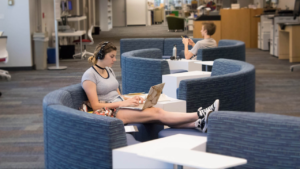
While our users are enthusiastic about our
moving deliberately toward delivering more resources and services
electronically, they are also emphatic that our buildings must be
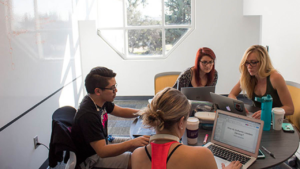
more than repositories for books, journals, and archives. Our library
buildings must also be spaces that are inviting and comfortable
and that provide for a variety of study preferences both for individuals
and groups.
As I reflect on what I hear from our users,
it seems evident that for the immediate future the academic library
will be both a virtual place and a physical space. We will not be
able to choose one or the other. Rather, our challenge will be to
maintain a balance between the two by making thoughtful decisions
based on the needs and desires of our users. We will need your assistance
to do that.
Bonnie Clemens
Director of Libraries
bonnie.clemens@libraries.claremont.edu
|