Teaching, Learning,
& Library Research

Would you like
  • • your students to base their research projects on reliable information?
  • • your students to look beyond Google for their research?
  • • your students to critically evaluate the information they find?
  • • to incorporate the most up-to-date best practices to facilitate student learning in your courses?
  • • to help your students become independent, lifelong learners?
  • • to design assignments that promote academic integrity?
Faculty/librarian workship, January 2008.

Faculty/librarian workshop, January 2008.

More than twenty faculty who answered yes to these questions participated in the Designing & Implementing Student Research Projects for Maximum Learning workshops offered by the Libraries in partnership with Laurie Richlin, Director of the Claremont Graduate University Preparing Future Faculty & Learning Communities Program. Dr. Richlin also serves as Director of the Lilly Conference on College and University Teaching - West, Executive Editor of the Journal on Excellence in College Teaching, and President of the International Alliance of Teacher Scholars.

These very practical half-day workshops, offered in August 2007 and January 2008, began with a presentation and discussion led by Dr. Richlin, which focused on scholarly teaching, learning objectives, teaching methods, assignments, and assessment, including developing effective rubrics to evaluate student work. Following Dr. Richlin’s presentation and brief presentations focused on resources available from the Libraries’ Special Collections and the Claremont Colleges Digital Library, faculty worked on developing research assignments for one of their courses. Each faculty member was paired with a librarian subject specialist, who could assist in identifying library resources and services of particular relevance for the course. Faculty/librarian pairs worked together to develop innovative research assignments and to enhance the potential for student success through integration of research resources and skills throughout the course. The workshop concluded with lunch and a lively, engaging discussion about plans that had been developed during the morning.

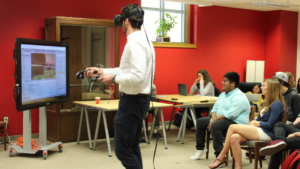
Dr. Richlin, Director of the Claremont Graduate University Preparing Future Faculty & Learning Communities Program, presenting during the January 2008 faculty/librarian workshop.

Dr. Richlin, Director of the Claremont Graduate University Preparing Future Faculty & Learning Communities Program, presenting during the January 2008 faculty/librarian workshop.

What were some of the new ideas for collaboration that resulted from the workshops? Librarians were added as “instructors” to Sakai course sites, allowing them to post materials to those sites: basic research tips for one class, guidance for specific course assignments for another, pointers to relevant databases for another. Research instruction took place more than once during the semester at strategic times in relationship to the research assignments, sometimes in the library, sometimes in the classroom. Individual undergraduate and graduate students were paired with librarian subject specialists for research guidance. Following a research instruction session in the library, students were required to meet, individually or in small groups, with their course librarian for more in-depth focus on their specific research interests.

As a mid-semester follow-up to the August workshops, faculty who had participated were asked to reply to a brief survey. Here’s what some of them said.

About the workshop:
  • I felt very affirmed as an instructor.
  • I took away from the session the importance of asking those basic questions and mapping the pedagogical goals and approaches for each course.
  • The simple pedagogical reminders that the workshop included were a big help.
  • The matching of one librarian per instructor was great.
  • The open discussion at the end was also very informative. I enjoyed hearing about what other people are doing.
About how the workshop affected their course/teaching:
  • My syllabus contains an updated assignment description that has clearer grading criteria and instructions for database searches.
  • I really feel that this is the first time I have been able to use the librarians to help me in my teaching.
  • [It helped in] focusing the assignment more clearly.
About the results for their students:
  • The students are... doing superior research.
  • I feel the students are far better prepared than the last time I taught the class.
Faculty/librarian workship, January 2008.

Faculty/librarian workshop, January 2008.

These workshops will be offered again during Summer 2008. If you would be interested in participating and if you have suggestions about when during the summer the workshops should be offered for maximum participation, please contact Gale Burrow, Coordinator of Instruction for the Libraries.

Gale Burrow is the Coordinator of Instruction for the Libraries and can be reached at gale.burrow (at) libraries.claremont.edu.

Image of cover of this issue in print.

Contents

Featured Articles

Director’s Column

Collaboration for Learning
& Teaching in Claremont

CCDL Update

Senior Theses from
The Claremont Colleges

Faculty Perspectives

Undergraduates Using
Special Collections

From Special Collections

Edward John Trelawny Collection
Teaching, Learning,
& Library Research
Discovery & Access Tools
in the Libraries

Departments

Exhibits
Meet Your Librarians
New Staff at the Libraries
What’s New at the Libraries
Claremont Discourse
New & Trial Databases

Colophon

Connections is published twice each year for The Claremont Colleges community by the Libraries of The Claremont Colleges: Honnold/Mudd, Denison, Seeley G. Mudd, and Sprague.

© Claremont University Consortium. All rights reserved.